Saturday, 6 November 2010

Chim Chimney

I love Paris roofscapes.

I love going round to friend's houses who live on the upper floors of their apartment buildings, and looking out of their windows to see the complex juxtaposition of roof tops. Part of the pleasure are the chimneys. Paris not only gives good lamppost, it gives good chimney. There are hundreds of chimneys, brick ones, metal ones, stone ones, clusters of them, solitary ones. Over the last year I have slowly built up a chimney collection. The way you do.

Here is a long view showing rows and rows of chimney pots.
Sometimes the chimneys step down.
Sometimes they're in long lines, or small clusters.
Sometimes they gather together in flocks.
Sometimes they zig.
Sometimes they reach up to catch aeroplanes, and zag.
Sometimes they serve as planters for the Eiffel Tower.
Sometimes they even serve as candles.
They usually have hats to keep out the rain.
But not always.
Sometimes they look great in the foreground.
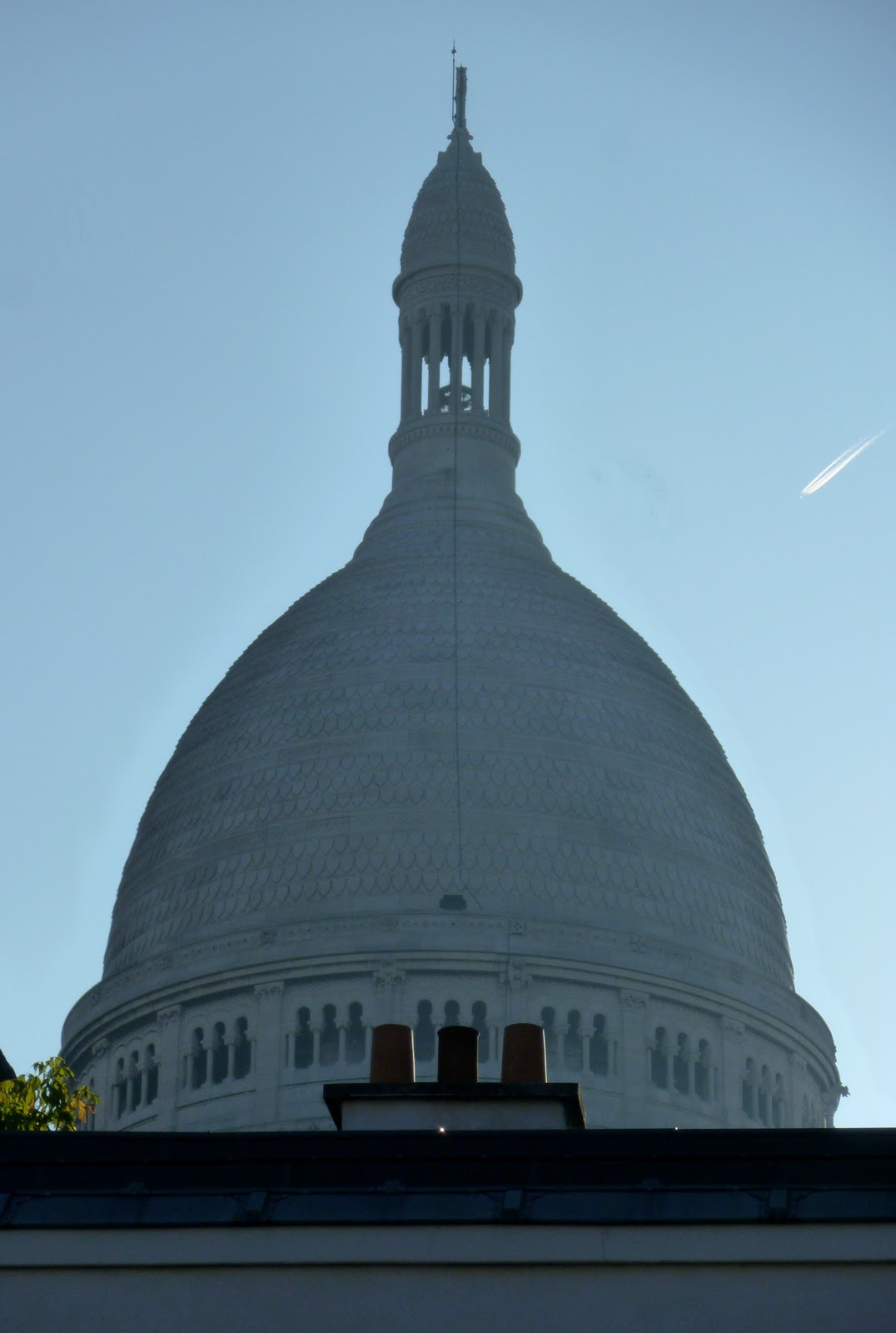
And sometimes they make a fantastic backdrop. 


Wednesday, 3 November 2010

Blue, turquoise, green

I saw this beautiful mosaic lettering on the facade of the église Saint-Jean de Montmartre, a brick clad reinforced concrete church, built between 1894 and 1904 on Place des Abbesses. The glass mosaics are tiny, no more than 5mm x 5mm. I had some fun with the photos I took. 
The mosaic tiles are lovely rich blues, turquoises and greens. I browsed though my photo collection looking for blues, turquoises and greens and came up with these.

Blue.
Turquoise.
Turquoise, green.
Green.

A lot more blues, turquoises and greens can be seen on my flickr account


Sunday, 31 October 2010

Blenheim Park, Woodstock

It's the school holidays at the moment and we just spent a few days in the UK. Yesterday afternoon we went to Woodstock to go for a walk in Blenheim Palace's 2100 acres of parkland. The park was breathtaking. Needless to say the autumnal colours are as good in the UK as in they are in France.

These were the first trees we came across. They had obviously been trimmed recently (by livestock apparently. Sheep were in this field).
When I studied architecture a hundred years ago, we used ink pens to draw. If we were feeling a little bit extravagant we would buy Letraset lettering, transferrable lettering that you would painstakingly 'transfer' onto your drawings letter by letter (yes, it was as bad as it sounds). If you were feeling positively rich you would buy Letraset trees and people.  These trees here look a lot like Letraset trees.

Yesterday the sun was struggling to shine through the clouds.
I loved this tree with its' silvery bark and caricature shape. It's a beech tree, but looks a bit like a eucalyptus tree, (Bruce)
The lake and trees beyond looked beautiful framed through the trees.
Not to mention the trees beyond the trees.
I loved the silvery grey roots of the beech trees...
...and the bridge across the lake, framed in fiery orange and yellow.
And here is some painting with trees.
And then to finish off, a bit of architecture.
More pictures of Blenheim Park can be seen here. Just gorgeous.


Tuesday, 26 October 2010

La Ligne de Petite Ceinture de Paris

Around the city of Paris, just within the dreaded Paris ring road, the périphérique, is an old disused tramway, La Ligne de Petite Ceinture de Paris. It is 32 kms long and was built between 1854 and 1869. Initially it was  mainly used for transporting goods, with the exception of a small section near Porte d'Auteuil to the west of Paris which transported passengers. From 1862 passenger traffic was started on other parts of  La Ceinture. At first just one train was scheduled per day, but by 1878, six trains were scheduled per hour. They would take 1h10 mins to make the tour of Paris. Gradually, however, between 1900 and 1934 the number of passengers using the Ligne de Petite Ceinture de Paris slowly declined, until traffic was completely stopped in 1934, with the exception again of the section near Porte d'Auteuil which continued running until 1985.

Nowadays the Ligne de Petite Ceinture de Paris is in most part abandoned, though sections of it have been embraced by local communities who have cleared away the rubbish and created planted gardens and allotments with picnic areas, to be enjoyed by local Parisians.

Below is a section between Rue du Ruisseau and Rue du Poteau in the 18th arrondissement that has been done up by the local community.
Just along from this part of the tramway, between Rue du Poteau and Avenue St Ouen is a more neglected section with lots of rubbish in the bushes and impressive graffiti along the walls.
The brick arches and column details are rather intricate.
At what would have been a station at Porte de St Ouen is a severed platform.  

The building that bridges the rails here is a shop selling all sorts of old tat from shopping caddies, to tins of beans, to cheap plastic toys, to screw drivers, to obscure wafer biscuits, to plates and saucepans.
I found this here for 1euro. Cheap at twice the price I say!
Here's a link with lots of information about the Paris Tramway http://www.petiteceinture.org/accueil.html
and here's a link to the Wiki page http://fr.wikipedia.org/wiki/Ligne_de_Petite_Ceinture